Saturday, May 31, 2014

Jin Ramen: Soup, Sandwich, and Sage advice!


By Benjamin Ramos Rosado, http://Sofritoinmysoul.blogspot.com

After a particularly stressful visit to City College’s financial aid office, I decided to drown my sorrows in a bowl of Ramen.  Not a bowl of that disgusting sodium-full swill you buy 3 for a dollar at the bodega; I’m talking about a bowl of Japanese Ramen filled to the brim with vegetables, noodles, and pork.  A bowl of soup that warms your belly and soothes the soul. The only place to find that type of solace in Harlem is at Jin Ramen.

Recently featured on Eater.com and Serious Eats, Jin Ramen is a chic little Japanese noodle shop, which has become popular with neighborhood locals and City College students. With 9 tables, a noodle bar, and 2 high top family style tables, Jin Ramen is a casual and cozy place to relax, read, and enjoy delicious food. 

Within minutes of my arrival, my server greeted me with a smile and a menu.  Jin Ramen’s servers are welcoming, attentive, and timely.  My only complaint is the number of servers that tend to you.  Sometimes, you get two or three people taking your different orders; it makes it hard to keep track of who is bringing you what and who to tip at the end of the meal.  

As I reached into my book bag to put away my financial aid paper work, I made eye contact with my neighbor to the right, a young Latino City College student. He said hello and I smiled back; he noticed my paper work and asked me if I worked at the Financial Aid Office. I shook my head and told him I was an Undergraduate transfer student starting in September. 

His eyes bulged out of his head and he immediately asked my age.  I must’ve been tired and flustered, because I told him my real age; usually I reply, “None of your damn business.” Apparently, I must’ve been the oldest person he’d ever met, because he kept repeating, “You’re (my age) and still an undergrad?” over and over in full voice.

Resisting the urge to curse him out or flip him off, I explained that I took a few years off to work, volunter with social justice campaigns, and travel.  He replied, “That’s cool!  I bet you’ve been EVERYWHERE IN ALL THOSE YEARS!”  I forced a friendly smile and regretted not cursing him out or flipping him off. 

Hoping to end our encounter, I turned my attention to my menu, but unfortunately he didn’t take the hint and began telling me his life story.  His name was Jason, he was 18 years old, and he mentioned that he didn’t know much about ramen.  I explained that ramen is a popular Japanese soup with Chinese style wheat noodles in a chicken or pork based broth with any type of meat, but usually pork. Intrigued by my explanation, he opened his menu and quieted down for a few minutes.  The silence was exquiste.

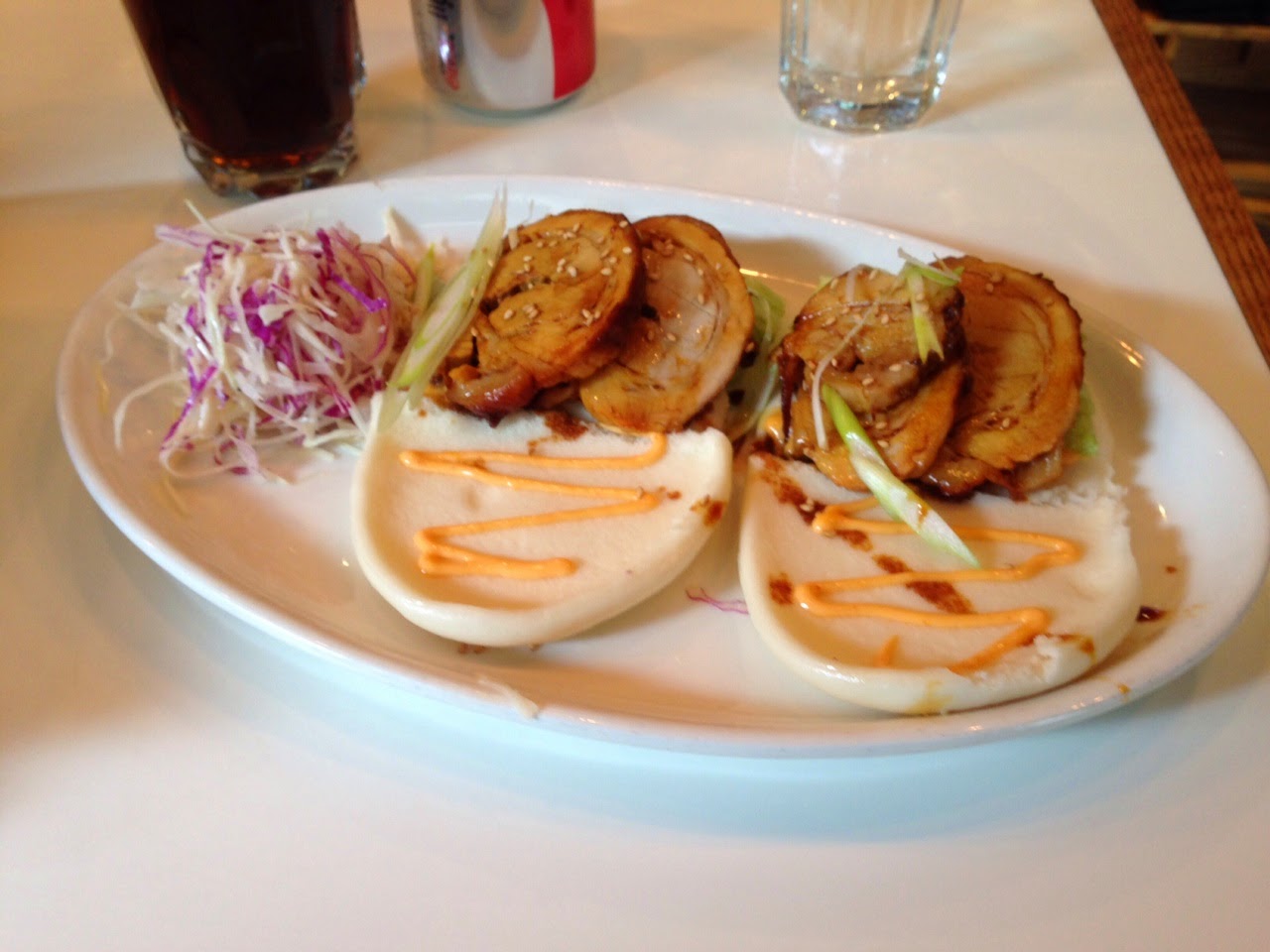
Jin Ramen’s menu is divided into 4 sections: Appetizers, Ramen, Starters and Salads, and a section with Additional Toppings (See the full menu here).  Hungry and slightly annoyed, I ordered my favorite appetizer, the Steamed Pork Buns (2 Gua Bao buns stuffed with chashu pork, iceberg lettuce, and spicy mayo), and the Miso Ramen (Miso broth with sauteed corn, leeks, scallions, bean sprouts, chicken sausage, pork belly, bok choy, and nori) for my entree.

Jason ordered the traditional Shoyo ramen, which comes from the Chinese immigrant community of Yokohama, Japan. It’s a brown broth made from a chicken and vegetable stock (blended with soy sauce, garlic and ginger) with noodles, green onions, and slices of pork.

As we waited for our dishes, Jason inquired about my visit to the Financial Aid office; I told him I was there to pick up FAFSA and TAP paperwork.  Immediately, he advised me to apply for FAFSA online, because I’d be able to simultaneously apply for TAP as well.  He walked me through the process on his smartphone.  He also showed me a few scholarship sites and assured me there had to be money out there for “old people” like me returning to school.  

I overlooked the insult and continued to listen as my server placed my Steamed Pork Buns in front of me.  Jason's eyes bulged out of his skull again; I could tell he wanted to taste one of the buns.  I offered him one, but he said no.  I placed one on a small plate and told him to consider it a thank you for his advice.  He grinned ear to ear and eagerly bit into it.

Steamed Pork Buns are a Taiwanese street food that have become popular in many Asian restaurants.  The buns, known as Gua Bao, are made by steaming dough in Bamboo steamers, which gives them a uniquely soft and moist texture.  The sweet and fluffy buns were stuffed with chashu (braised) pork, seasoned with soy sauce, garlic, mirin and other spices.  The chashu pork was soft and perfectly seasoned.  The crunchy Iceberg lettuce had a refreshing clean flavor and the spicy mayo added a wonderful hint of heat to the dish.  Jason loved the bun and thanked me for my generosity.  As I finished my last bun, he showed me some apps I could download for further financial aid information.


Before I knew it, our wonderfully aromatic ramen bowls arrived.  The steaming miso broth was rich and salty; the leeks, bok choy, scallions, bean spouts and leeks were crunchy and well cooked.  The corn added a delightfully sweet contrast to the briny broth.  The pork belly and chicken sausage were soft, savory, and flavorful.  The noodles were delicious and fun to eat; there’s nothing like slurping ramen noodles.


Jason thought his Shoyo Ramen was delicious and said, “It was WAY better than Top Ramen!” High praise, indeed!  He assured me he would be back with his friends. 

As we both prepared to leave,  I thanked Jason for his advice and he thanked me for his crash course on Japanese food.  It just goes to show you, that when people of different generations listen to each other amazing things can happen.  Now listen to one of your elders -I’m really not that old-and go have an amazing bowl of ramen.  Don’t take my word for it, go eat for yourself!  Buen Provecho! 

Jin Ramen
3183 Broadway
New York, N.Y. 10027
646-559-2862

HOURS:

ATMOSPHERE: Friendly, energetic and fun.

SERVICE: Good.

SOUND LEVEL:  Conversational.

KID FRIENDLY: No.

RECOMMENDED DISHES:  The ramen section of the menu is amazing.  Check out the menu: http://www.jinramen.com/menu

BEVERAGES: Soda, Japanese Beer, Sake, Infused Sakes, and cocktails.  Check out the bottom section of the menu: http://www.jinramen.com/menu


PRICE RANGE: Check out the menu: http://www.jinramen.com/menu

Jin Ramen on Urbanspoon

Saturday, April 5, 2014

A Spoonful of Sofrito: Mountain Bird

Mountain Bird
A Spoonful of Sofrito:
A pinch of advice that will add a lot of flavor to your life.


For amazing French cuisine uptown, visit Mountain Bird in Harlem; excellent atmosphere, great service, and amazing food.  

Check out the Quinoa Salad:


Chicken Schnitzel with Wild Rice Pilaf and Sauteed Vegetables:


Warm Dark Chocolate Brownie with Vanilla Bean Whipped Cream:


Sunday, March 30, 2014

Indian Road Cafe: Meatloaf, Malva, and Mandela!


By Benjamin Ramos Rosado, http://Sofritoinmysoul.blogspot.com

Like many activists, I was deeply saddened when Nelson Mandela passed.  Out of respect for this incredible man, I attended several commemorations of his life and read the various articles published about his human rights work.  But, it wasn’t until I visited one of my favorite eateries-Indian Road Café-that I truly gained an appreciation for the life and legacy of Nelson Mandela.

Indian Road Café is a moderately sized out-of-the-way café/restaurant in Inwood with amazing desserts, seasonal menus, and occasional guest chefs. The cafe features a bakery section, fully stocked bar and ample seating for all day meal service. Wooden tables, exposed brick, and dim lighting, make it the perfect place to kick back and enjoy an afternoon of reading, writing, or relaxation.  I hate to sound like a tired cliché, but I love to go there to write; in fact, I conceived the idea of this blog there.

After an especially strenuous day, I decided to have dinner at the café and unwind with a great meal.  As I entered, I immediately heard mid-tempo African rhythms and noticed the beautiful photography on the walls.  The photos were of South African landscapes, rural communities, and people. 

The most striking photo was of a young Black man speaking to a crowd of students; it took me a moment to realize that it was Nelson Mandela.  His smiling face was captured in mid chant with his fist raised in the air.  Its beauty was striking, yet haunting; who could’ve predicted that the charismatic young man in the photo would one day become one of the most influential human rights advocates in the world.

After admiring the exhibit, I sat down and was immediately greeted by my server.  The café’s wait staff is always sweet and attentive; I’m always impressed with their knowledge of the menu and the food preparation.   I asked about the South African theme and he explained that the café was featuring Chef Chris van der Walt, a guest chef who had prepared a special South African Tasting menu; a type of meal consisting of sample portions of many different dishes served in several courses for a set price.

The café decided to pair the guest chef’s tasting menu with a local artist’s photo exhibit of South African natural beauty and historic moments.  The idea was brilliant!  They were honoring Mandela’s life through music, art, and food. 

Intrigued, I decided to review the tasting menu, which featured an appetizer, Vetkoek (Deep fried dough) with Cheddar cheese, Apricot jam and Traditional South African Beef jerky and Dried Sausage; a first course of Chilled Lightly Curried Pickled Haddock, Traditional Lamb Sausage or Chilli Bites (chickpea fritters); a second course of Bobotie (meatloaf with a custard and sliced almond crust) with White rice, Vegetable Biryani (rice pilaf), or Bunny Chow (traditional lamb stew with tomatoes); and for dessert warm Malva Pudding with vanilla ice cream. 

There was no way I was going to pass on this incredible opportunity, so I chose the tasting menu and ordered the Traditional Lamb Sausage and Bobotie with White rice.  As I waited for my appetizer, I started to read an article inside the exhibit introductory folder.  Apparently, Mandela enjoyed sampling the cuisines of the countries he visited; he enjoyed dining with dignitaries and world leaders while discussing international issues; and loved his native fare so much he would have his personal chef ship South African food to him.

I couldn’t believe it: Nelson Mandela was a foodie!  I’m sure he never used that word to describe himself, but for all intents and purposes, he was one. As my server handed me my appetizer, I joyfully shared this discovery with my server, he smiled and said, “Cool!”

The flakey and soft Vetkoek was stuffed with the cheddar cheese and apricot jam.  The cheese provided a wonderful sharp saltiness to the sweetness of the jam and fried dough.  The South African beef jerky was savory and chewy; the dried sausage had a grainy consistency and a delightful earthy flavor.  The appetizer’s flavors and textures worked well together.


Within minutes of finishing my appetizer, my first course arrived, which would’ve pleased Mandela who valued punctuality, especially in food service.  The Traditional Lamb Sausage was paired with a tomato onion gravy and pap, a polenta made from ground maize.  The lamb sausage was soft, moist and delicious.  The sweet and acidic tomato onion gravy gave the rich and creamy pap a wonderful kick of flavor.  After learning that Mandela loved umphokoqo (pap with sour milk and sweet chicken), I was anxious to taste pap and see what all the fuss was about.  It was sweet, creamy, and perfectly complemented the lamb sausage.


My second course, the Bobotie was served with white rice and shredded coconut and three condiments (Pico de gallo, Apricot Chutney and a creamy banana mash).  The custard was a bit bland, but the crunchy sliced almonds added an interesting nutty flavor and textural contrast to the savory meatloaf.  The white rice with shredded coconut was sweet, buttery and simple.  The condiments added a unique dimension to the dish; the pico de gallo added heat and acidity, the apricot chutney was sweet yet spicy, and the banana mash was creamy and rich.  I wasn’t a fan of the banana mash, but when mixed with the other ingredients it was palatable.


The tasting menu’s featured dessert was Warm Malva pudding with vanilla ice cream.  Despite being an advocate of healthy eating, Malva pudding was one of Mandela’s weaknesses.  According to the article, he ate it in copious amounts whenever it was served. 

The malva pudding had a moist sponge cake texture to it.  It was rich, sweet, and when paired with the cold vanilla ice cream, was truly decadent. It was the perfect way to complete the tasting menu.


I’m glad I visited Indian Road Cafe that night, it changed my perception of Mandela forever.  He went from being an iconic untouchable political figure into an ordinary guy I could share opinions with about food. I wonder, if we had ever met would we have talked about politics or food.  I’ll never know, but what I do know is that my little cafe in Inwood is amazing and I would’ve recommended it to him.  Don’t take my word for it, go taste for yourself.  ¡Buen provecho!


Indian Road Café
600 West 218th Street @ Indian Road
New York, NY 10034
Tel: 212-942-7451

HOURS: Visit the website for their schedules.

ATMOSPHERE: Causal and relaxed. 

SERVICE: Good.

SOUND LEVEL: Conversational. 

KID FRIENDLY: Yes. 

RECOMMENDED DISHES:  The current winter menu is good, but the spring menu is coming out soon.  Check the website for the Spring entrees.

BEVERAGES: Soda, liquor, water, various types of teas and coffees.


PRICE RANGE: See the website.

Indian Road Café on Urbanspoon

Sunday, March 9, 2014

A Spoonful of Sofrito: Ch-Ch-Ch-Chia Seed Pudding

Ch-Ch-Ch-Chia Seed Pudding
A Spoonful of Sofrito:
A pinch of advice that will add a lot of flavor to your life.


Creamy Chocolate lava cake, tart key lime pie, rich cheesecake or a moist slice of Tres Leches are all an incredible ooey-gooey way to end a meal, but sometimes a healthy alternative like Chia Seed Pudding can truly hit the spot.

Last month, I discovered this delicious dessert thumbing through the pages of Food Network Magazine (one of my favorite foodie magazines).  Chia seeds are the newest super food craze because of their high fiber content, omega 3 fatty acids, and rich calcium content. 

Cultivated by the Aztecs for thousands of years, Chia seeds are becoming wildly popular in North America.  Homeopaths and mainstream doctors alike recommend adding chia seeds to smoothies, salads, and oatmeal to increase their nutritional value.  CBS’s Dr. Oz has become a chia-champion; he talks about them every time he discusses nutrition on his show.  He considers them necessary for living a healthy lifestyle. 

If you’re wondering if these are the same seeds you spread on ceramic pots to grow those little green Chia pet Afros, they are!  Those micro-greens are edible and taste like alfalfa sprouts (yes, I’ve tasted them!); most people don’t know they’re added to salads all of the time. 

Dry chia seeds taste like poppy seeds and aren’t all that interesting, but when you prepare them in this dessert their flavor blends very well with the sweetness of the fruit, nuttiness of the almonds and the rich full flavor of the yogurt.  They provide a delightful crunchiness to the dessert as well.

If you’re like me, you want a dessert that’s going to satisfy your sweet tooth, especially after a savory meal.  Chia Seed Pudding does exactly that and more.  It’s delicious, filling, and won’t raise your cholesterol, spike your blood sugar, or make you feel like a gluttonous slob.  So at the end of dinner, pass on the Tiramisu and make yourself some Chia Seeding Pudding!  Don’t take my word for it: Go taste for yourself!  ¡Buen provecho! 

Click on this link for the Chia Seed Pudding recipe:

Thursday, February 27, 2014

Massawa: Touch, Taste, and ENJOY!


By Benjamin Ramos Rosado, http://Sofritoinmysoul.blogspot.com 

There’s nothing more primal and satisfying than eating with your hands.  Many will try to convince you that it’s unsanitary and uncivilized, but what they fail to realize is that this ancient and widely practiced method of eating creates a uniquely intimate bond with your food.   Inspired by an article I read (“Eating with your hands is healthier” by Stasia Bliss published on guardianlv.com), I decided to visit to one of my favorite African restaurants in the city, Massawa, where eating with your hands is all the rage.

New York City is full of Ethiopian/Eritrean restaurants, but few have the authenticity and allure of Harlem’s Massawa.  Small wooden tables, a fully stocked bar, beautiful East African art, and soft lighting, make Massawa a warm and cozy place to enjoy dinner with family or friends.  It was the perfect setting to put what I learned from the article to the test. 

As I re-read the article, I asked my server if he thought eating with your hands was healthier than using utensils; he vehemently agreed!  Having been raised in rural Eritrea, eating with his hands was the norm.  He said this method of eating makes you acutely aware of your hygiene (you always wash your hands before and after a meal); it helps you get a tactile sense of your food (you don’t eat what feels too hard or slimy); and it helps you digest better, because you enjoy the experience.  He thought the topic was interesting and asked one his fellow servers to join the conversation.  Massawa’s servers are always friendly, helpful, and attentive.

It was a cold night, so I decided to start dinner with a cup of Massawa’s Special spice tea. Made from cinnamon, cardamom, and clover, this tea’s an Eritrean staple.  Usually you drink it after a meal, but I needed to get the chill out of my bones. It was absolutely delicious; the flavor of each of those earthy and rich spices came across brilliantly.  When I added half a packet of Splenda to the tea, the hint of sweetness made it all the more incredible. 


Feeling warm and hungry, I looked over the appetizers (http://www.massawanyc.com/#!menu) and was torn between the Beef Sambusa (Four pastry shells filled with ground beef flavored with spices) and the Vegetable Sambusa (Four pastry shells stuffed with a variety of vegetables).  I ordered the Vegetable Sambusa, because it would be healthier and not too filling.

According to the article, when you touch your food before eating it the millions of nerve endings on your fingertips send information immediately to the stomach; this stimulates the stomach to produce the enzymes needed for digestion.  Keeping this in mind, I decided to feel the sambusa before eating it.  It was warm, flaky and soft; I was happy to notice that, for a fried appetizer, it wasn’t greasy.  I couldn’t tell if my stomach was producing digestive enzymes or not, but my salivating mouth was prompting me to eat.

The sambusa was simple and delicious.  It contained diced carrots, spinach and potatoes and was paired with two dipping sauces. One was a vinegar, green pepper and garlic mix and the other was Azawe, an Ethiopian/Eritrean marinade made with berbere, oil, and water or Tej (an Ethiopian honey wine).  The vinegar mixture added a wonderful hint of acid and crunchy texture to the appetizer; the Awaze was spicy, yet subtle and had an interesting earthy flavor as well. 


Having sufficiently stimulated my appetite, it was time for the main event!  Massawa’s entrée menu is divided into 6 sections (See the menu: http://www.massawanyc.com/#!menu2).  Usually, I order Lamb or Beef, but I decided to break with convention and ordered seafood.  The Monkfish (Tenderly and slowly simmered with rosemary, lime, garlic and black peppers), Shrimp Tebsi (Shrimp delicately sautéed with tomatoes, peppers, onions and berbere) and Shrimp Hiwas (shrimp sautéed with collard greens or cabbage) were all tantalizing in their own way, but I decided to order the Shrimp Combo, which combined elements of the Tebsi and Hiwa. 

The Shrimp combo was served with a small side of salad (lettuce and shredded carrots dressed with oil), pureed chickpeas, spicy shrimp (sautéed with onions and berbere), and mild shrimp (sautéed with tomatoes, and cabbage). The entrée also came with a side of Injera, a traditional Ethiopian/Eritrean flatbread made of Teff, a calcium rich grain.  It’s used to scoop up food and to sop up sauces. Injera is soft, moist and spongy to the touch.  It also has an elastic quality to it, but becomes firmer as it cools.  It tastes a bit sour, but is mostly bland.


As I looked over my entrée, I kept in mind one of the article’s most important points: Eating with your hands engages all your senses and keeps you “present” while you eat, this means you become aware of portion size and the quantity of the food you’re consuming. 


Impatiently, I tore off a piece of injera and scooped up some salad; it was light, crunchy and refreshing.  I could’ve eaten the entire portion in a few scoops, but decided to parcel it out throughout the meal. I knew the crunchy salad would add some texture to the rest of the meal.

The aroma of the spicy shrimp was too delicious to ignore, so I scooped some up with my bread and paired it with the pureed chickpeas.  It wasn’t easy to scoop the puree into the injera and shrimp, so instead I soaked the bread and shrimp into the puree. The chickpeas were well seasoned and provided a rich earthy taste to the combo.  The shrimp was delicious and intense, but the chickpeas and injera muted the flavor and made it easier to eat. The combined flavors of the injera, shrimp and chickpeas were balanced and complementary.

The mild shrimp was also good, but a bit bland on its own.  When it was combined with the acidic sweetness of the tomatoes, crunchy cooked cabbage and the side salad, it became delicious.

As I ate, I noticed I was eating slower and was judicious about portion size.  I wasn’t trying to race through the meal; instead I was savoring each bite and meticulously preparing each scoop of injera.  This type of focus isn’t present when we use utensils.  We use them as shovels to heave large forkfuls or spoonfuls down our throats so we can finish as soon as possible.  I felt very “present” and ate enough to satiate my hunger; I even had leftovers for lunch the next day.

After dinner, my server asked me if I wanted to order dessert, I declined, but reviewed the dessert menu nonetheless. Massawa’s menu features the standard dessert fare such as Tiramisu, Cheesecake and Rum cake.

To be honest, I can’t prove that eating with your hands is healthier than using utensils, but I can tell you that my dining experience was different and a lot more interesting.  I did feel an intimate connection to my food and was more aware of portion sizes.  Maybe, it was the power of suggestion or maybe not, who knows?  The one thing I am certain of is that the food at Massawa is wonderful! So put down the silverware, wash your hands and go taste for yourself! ¡Buen provecho! 

Massawa

1239 Amsterdam Ave

New York, NY 10027

(212) 663-0505

Website: www.massawanyc.com 

HOURS: Daily: 11:30am-11:30pm 

ATMOSPHERE: Causal and relaxed. 

SERVICE: Good. 

SOUND LEVEL: Conversational. 

KID FRIENDLY: Yes. 

RECOMMENDED DISHES: I love the lamb, beef and seafood Sections:  http://www.massawanyc.com/#!menu2 

BEVERAGES: Sodas, wine, missed drinks and teas ($3-$25). 

PRICE RANGE: Consult the menu link: http://www.massawanyc.com/#!menu2

Massawa on Urbanspoon